Photo: MTA
Riders on the 1, 2 and 3 lost Lower Manhattan service across four weekends in July and August while crews replaced switches near Chambers Street that had been in the ground for roughly three decades.
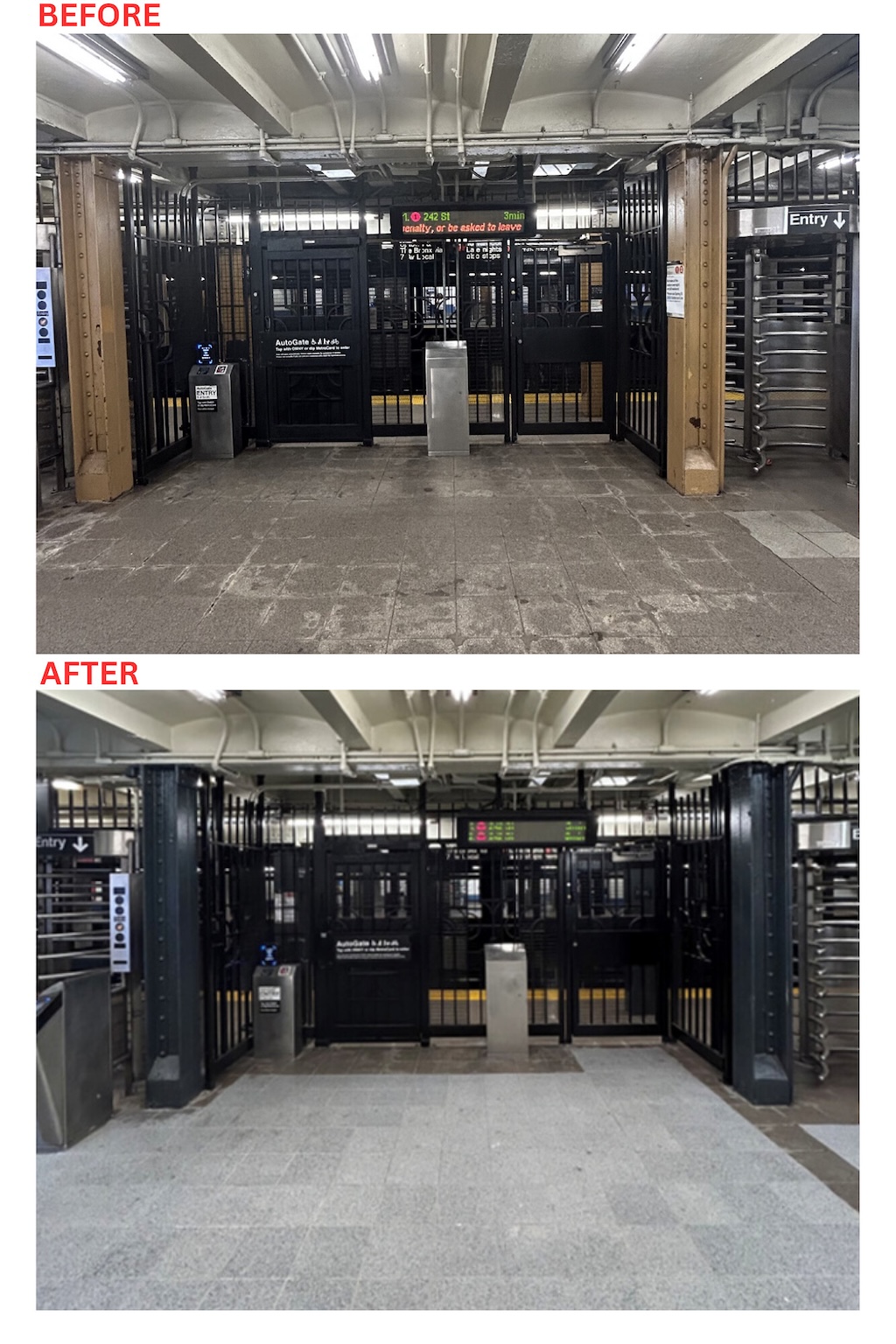
Three stations came out the other side looking different.
At Christopher Street-Stonewall, crews scraped and repainted 40,000 square feet and installed 20 new LED fixtures in the stretches of the station that had gone dim, according to the MTA. Benches were refinished, drains cleared and the HVAC system serviced. At Houston Street, one stop south, 45,000 square feet got the same repaint. Park Place, on the 2 and 3, accounted for another 38,000 square feet.
Between Christopher Street and Houston Street, the agency counted 12,500 square feet of masonry repairs. Across all three stations, crews rebuilt 3,000 feet of platform edge — the least visible item on the list, and the one the MTA connects most directly to service, since deteriorated platform edges are a routine source of the slow orders that stretch a normal trip.
The agency’s framing is that the outages were happening regardless, so it stacked work into them.
“While crews replaced critical track infrastructure that had outlived their useful lives, we took advantage of the required service outages to get additional work done to improve the customer experience at the impacted stations,” NYC Transit President Demetrius Crichlow said in the announcement. “We take service changes seriously, so we make sure to do work during those changes that ensure when riders return to their stations, they see the improvement.”
Bill Amarosa, Jr., NYC Transit’s executive vice president of subways, said in the same release that station conditions sit near the top of the agency’s list. “We are consistently working on making subway commutes more reliable, safe and efficient for all customers,” he said, “and that starts the moment riders enter a station.”
What the announcement does not include is a price tag. The MTA has not published a cost figure for the station work, and it is not clear from the release whether the three stations were done under one of the agency’s named station-refresh programs or simply folded into the switch replacement as opportunistic work — a distinction that matters for anyone trying to figure out whether the other stations on the line are next.
For anyone who spent two months rerouting around suspended weekend service, the ledger is now at least legible: four lost weekends, roughly 123,000 square feet of fresh paint across the three stations, 20 new lights at Christopher Street, and platform edges that should outlast the ones they replaced.